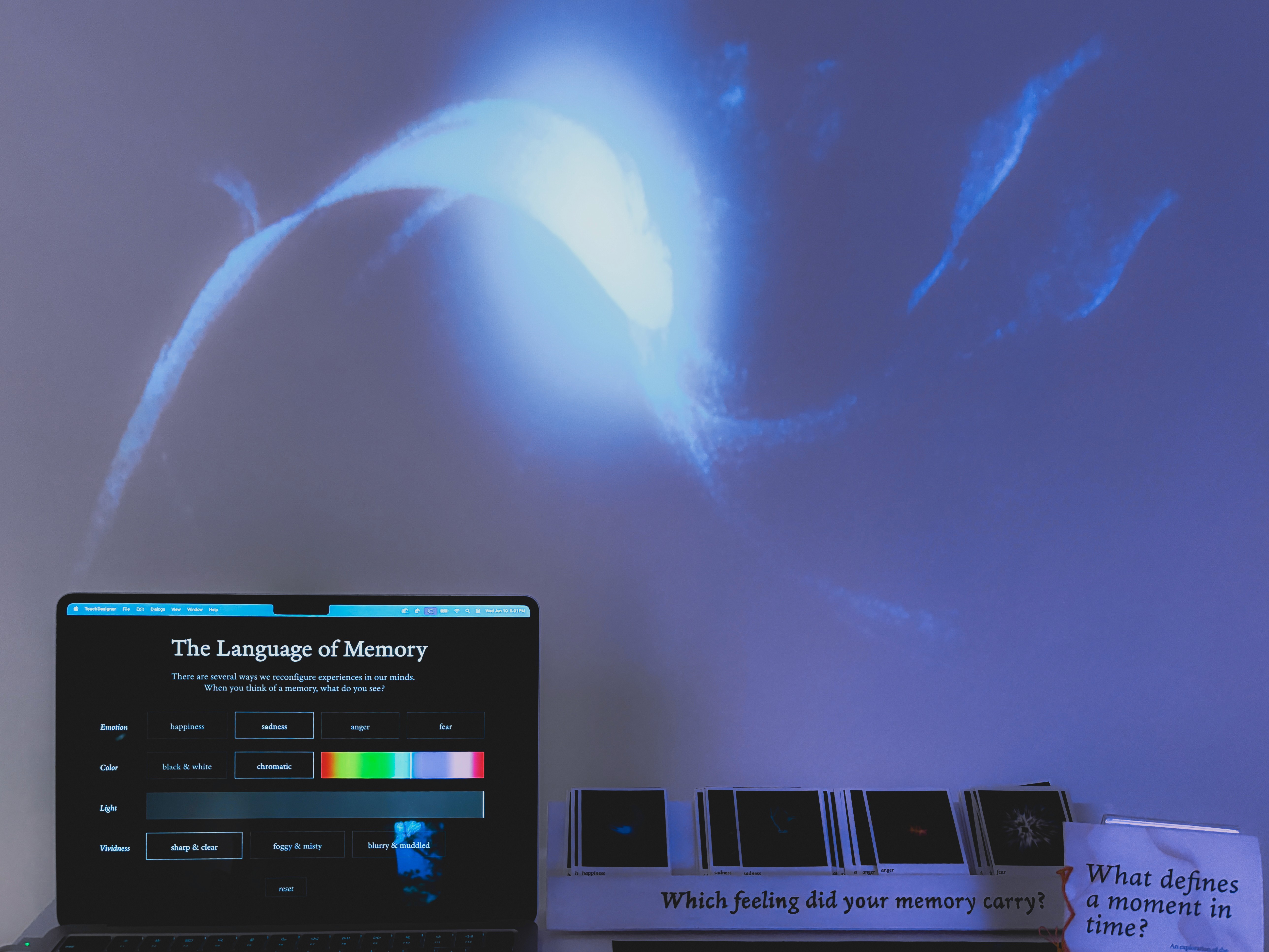
the language of memory
Exploring human memory & active Recall.
overview
A design research study on long-distance adult friendships and digital communication.
A design research study on long-distance adult friendships and digital communication.
Technology and social networks keep us more connected than ever, yet adults who move away from close friends often struggle to maintain a genuine sense of mutual care.
Our focus is on friendships that begin in person and later become long-distance. This research study aims to understand how adults use technology to navigate this shift, identify the factors that help maintain or hinder authentic connection across distance, and translate these findings into effective design.
Technology and social networks keep us more connected than ever, yet adults who move away from close friends often struggle to maintain a genuine sense of mutual care.
Our focus is on friendships that begin in person and later become long-distance. This research study aims to understand how adults use technology to navigate this shift, identify the factors that help maintain or hinder authentic connection across distance, and translate these findings into effective design.
project type
UX Research
my role
Design research
Visual Design
software
Figma
Dovetail
InDesign
team
danella l.
Hayden K.D.
Leslie K.


opportunity
When formerly co-located adult friendships become long-distance, how does technology facilitate this transition and help/complicate authentic connections?
In our current society, it feels like the quantity of messages and speed of response are treated as a way to measure how close or strong our friendships are. We assumed that improving the ease, efficiency, and expressive capabilities of a specific communication tool might improve the strength or quality of a long distance friendship.
research
Field Research: Surveys + Interviews
Our participants were 10 working adults who had experienced a move and the subsequent challenge of maintaining distance friendships.
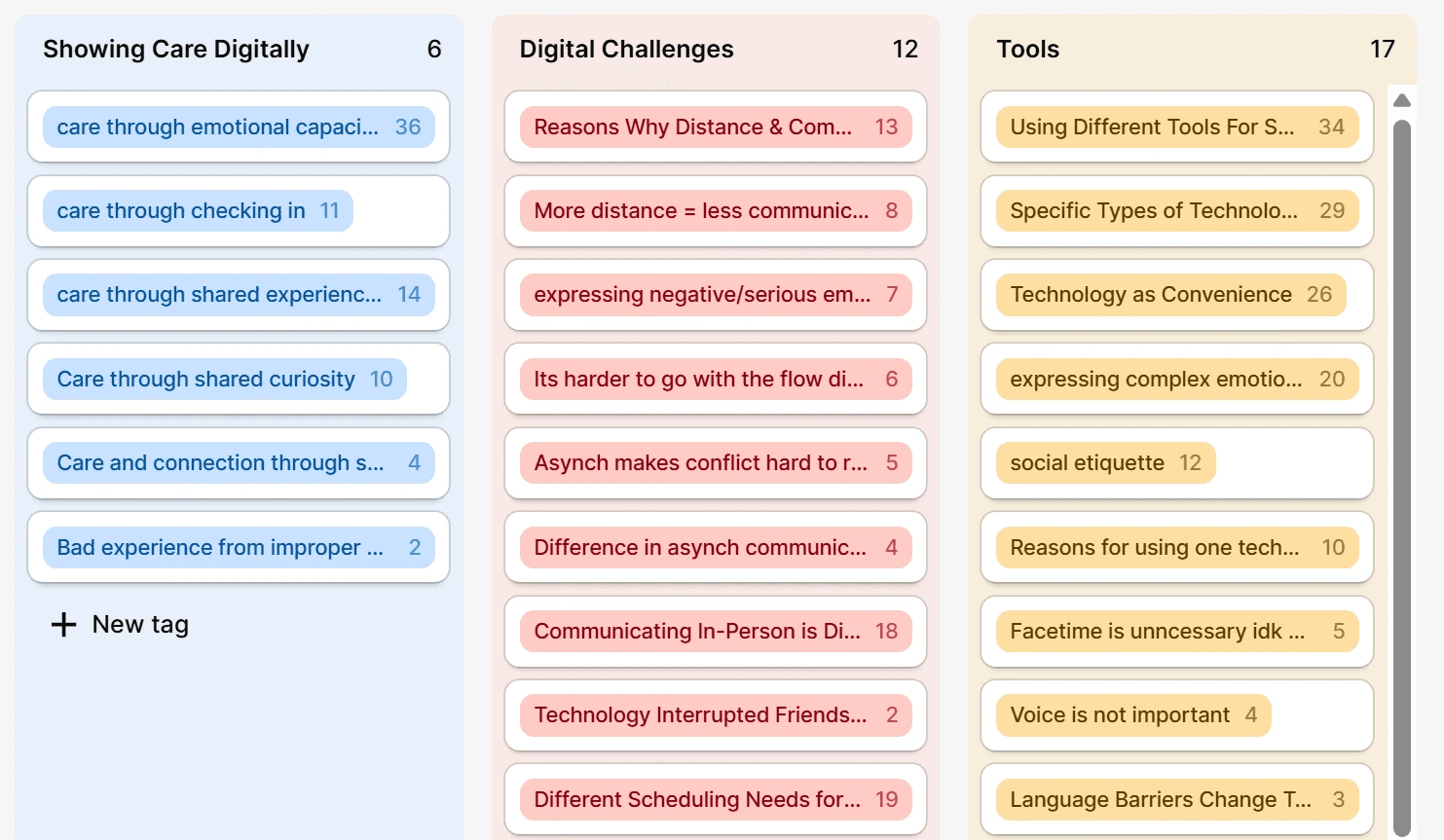
We asked them about the tools they use to stay connected, the kinds of digital conversations they supported, and how they felt each tool influenced the strength or closeness of the relationship.


Shifting Our Approach
Individual tools are flawed, but as a collection they allowed our participants to share a range of meaningful conversations with their friends.
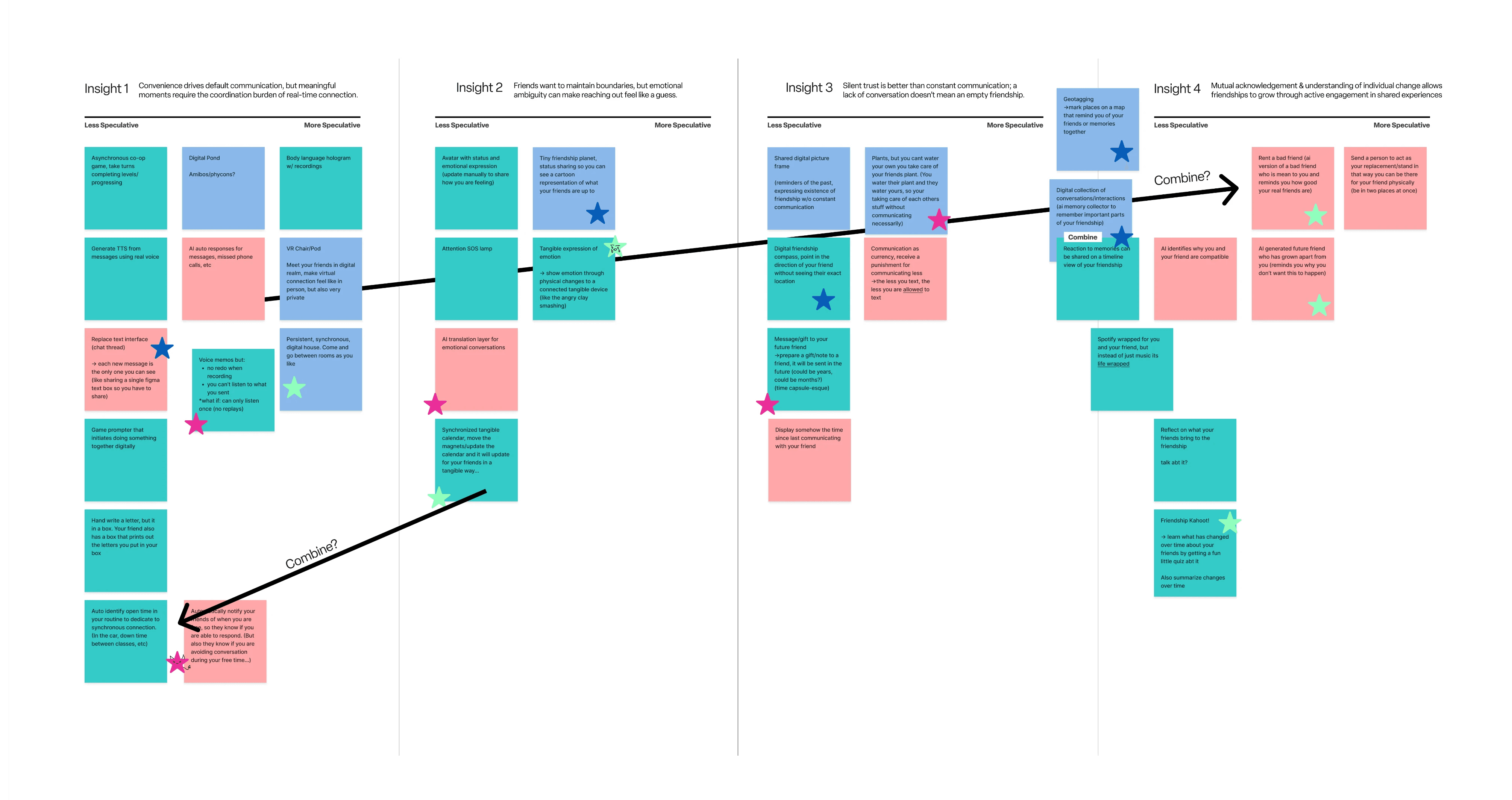
There is always room to enhance our tools, but we found that in striving for improvement, we cannot assume that improving the ease, efficiency, and expressive capabilities of digital conversation tools will always improve a friendship. We drafted fifteen design concepts catering to this new revelation.


Feedback Sessions
With our insights from primary research, we shifted our focus to concept ideation. We reached back out to four of our participants, and chose seven of our original concepts to present. During feedback sessions, two design concepts produced particularly relevant takeaways that touched on the interpretive labor of truly knowing another person. We incorporated these insights into two final concept revisions.

Friendship Compass
A simple compass that always points in the direction of your friend, regardless of how far away they are.

Substitute Friends
A world in which AI could act as a stand-in for a you when you don’t have time to talk to your friend.

Outcome
What is the future of communication interfaces?
Rather than trying to eliminate the challenges of human expression, communication tools should honor the reality that misunderstandings are part of being close, and that meaningful relationships endure precisely because friends can learn to navigate imperfections together.
Conversation is not the only way to communicate meaning-fully across distance. Our ideation and feedback sessions highlighted value of more passive exchanges of information that can happen continuously. Even if these exchanges do not communicate with any words, they add to the feeling of ambient closeness friends desire between conversations.
the language of memory
Exploring human memory & active Recall.
overview
A design research study on long-distance adult friendships and digital communication.
Technology and social networks keep us more connected than ever, yet adults who move away from close friends often struggle to maintain a genuine sense of mutual care.
Our focus is on friendships that begin in person and later become long-distance. This research study aims to understand how adults use technology to navigate this shift, identify the factors that help maintain or hinder authentic connection across distance, and translate these findings into effective design.
project type
UX Research
my role
Design research
Visual Design
software
Figma
Dovetail
InDesign
team
danella l.
Hayden K.D.
Leslie K.
opportunity
When formerly co-located adult friendships become long-distance, how does technology facilitate this transition and help/complicate authentic connections?
In our current society, it feels like the quantity of messages and speed of response are treated as a way to measure how close or strong our friendships are. We assumed that improving the ease, efficiency, and expressive capabilities of a specific communication tool might improve the strength or quality of a long distance friendship.
research
Field Research: Surveys + Interviews
Our participants were 10 working adults who had experienced a move and the subsequent challenge of maintaining distance friendships.
We asked them about the tools they use to stay connected, the kinds of digital conversations they supported, and how they felt each tool influenced the strength or closeness of the relationship.
Shifting Our Approach
Individual tools are flawed, but as a collection they allowed our participants to share a range of meaningful conversations with their friends.
There is always room to enhance our tools, but we found that in striving for improvement, we cannot assume that improving the ease, efficiency, and expressive capabilities of digital conversation tools will always improve a friendship. We drafted fifteen design concepts catering to this new revelation.
Feedback Sessions
With our insights from primary research, we shifted our focus to concept ideation. We reached back out to four of our participants, and chose seven of our original concepts to present. During feedback sessions, two design concepts produced particularly relevant takeaways that touched on the interpretive labor of truly knowing another person. We incorporated these insights into two final concept revisions.
Friendship Compass
A simple compass that always points in the direction of your friend, regardless of how far away they are.
Substitute Friends
A world in which AI could act as a stand-in for a you when you don’t have time to talk to your friend.
Outcome
What is the future of communication interfaces?
Rather than trying to eliminate the challenges of human expression, communication tools should honor the reality that misunderstandings are part of being close, and that meaningful relationships endure precisely because friends can learn to navigate imperfections together.
Conversation is not the only way to communicate meaning-fully across distance. Our ideation and feedback sessions highlighted value of more passive exchanges of information that can happen continuously. Even if these exchanges do not communicate with any words, they add to the feeling of ambient closeness friends desire between conversations.
other projects
Finding Music You Feel
Finding Music You Feel
mobile design
mobile design
Prototyping
Prototyping
Lumi: A Synchronized Solo Workflow
Lumi: A Synchronized Solo Workflow
Multimodal AI
Multimodal AI
Product Design
Product Design
Prototyping
Prototyping
The Language of Memory
The Language of Memory
Coming Soon
Coming Soon
UI/ux
UI/ux
design research
design research
exhibition
exhibition